The Most Available Solar Solutions in Kenya
Victor Gadamba
Author
Let us review the most common solar solutions in Kenya to help you understand the solution that may fit your needs.
Solar Street / Flood Lights
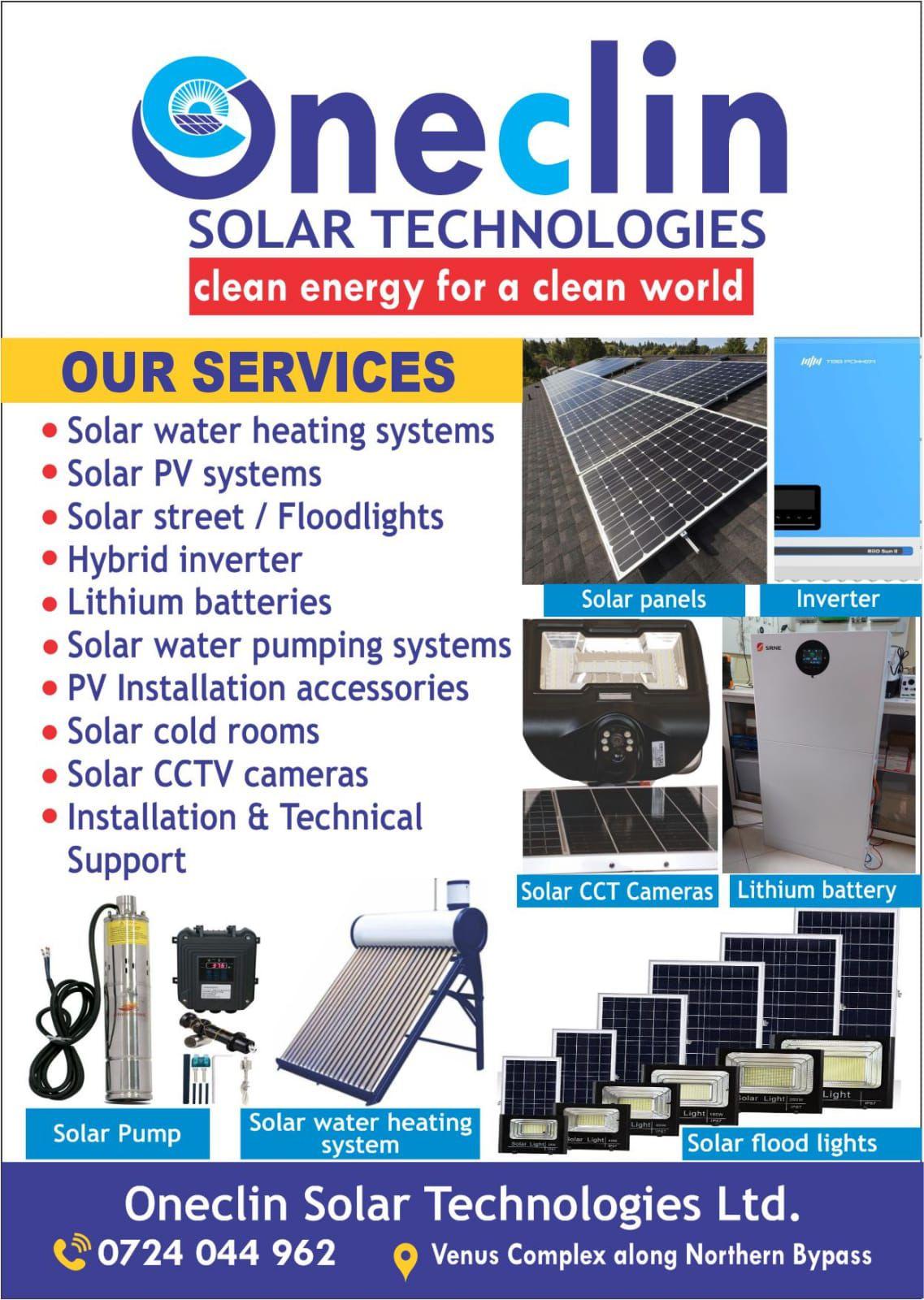
Most homes and businesses require security lighting. The most available solar lights in Kenya are solar floodlights and solar street lights. The difference between them is that solar streetlights are designed to illuminate long stretches of areas like streets, driveways, paths, and rectangular spaces, while floodlights are best-suited for broader angles. The brightness of either a solar streetlight or floodlight depends on how it is rated in watts. Therefore, a high-quality light of 600 watts should be brighter than that of 300 watts.
How do Solar Streetlights and Solar Flood Lights Work?
The answer is simple: solar streetlights and solar floodlights come with a small solar panel that captures sunlight and converts it to electricity. The electricity charges a small battery inside the light, which then powers the light. Therefore, each solar light is a combination of an external solar panel, LED luminaires, an internal battery, and a controller. They store energy during the day and automatically detect darkness in the evening to start shining at night. They are easy to carry around and simple to install.
The advantage of solar lighting in Kenya is that it is practical, cost-effective in the long run, sustainable, safe, and not affected by power outages or blackouts. Due to these benefits, many people are adopting solar lighting for homes, streets, and commercial premises.
Solar PV Systems (Photovoltaic)
When people say “my home has solar” or “I run on solar,” they are usually referring to a Solar PV system. This system uses solar panels, an inverter, and a battery. The panels capture sunlight and convert it to DC electricity, which passes through an inverter and is then stored in a battery or supplied directly to electrical outlets.
In Kenya, solar PV systems can be configured as grid-tied, off-grid, or hybrid systems. The hybrid configuration is the most popular, allowing solar power to supply energy while supplementing with other sources when needed. This is typically managed by a hybrid inverter and a transfer switch.
Off-grid systems operate entirely on solar power without relying on external sources, while grid-tied systems depend on the availability of the main power grid or generators.
Solar PV systems help reduce electricity costs and prevent disruptions caused by power outages. They are widely used in homes, businesses, schools, hospitals, churches, and other institutions.
Solar Water Heating Systems
A solar water heater uses sunlight to generate heat, which warms water stored in an insulated tank. The system retains heat and supplies hot water when needed through taps or showers. A complete system includes collectors, an insulated tank, piping, and temperature control mechanisms.
These systems are popular in homes, hotels, schools, hospitals, and other institutions where hot water is essential.
What Happens on Cold or Rainy Days?
The heated water remains hot due to insulation. If the hot water is depleted, backup heating elements powered by electricity warm the incoming cold water. The system automatically switches back to solar heating when sunlight becomes available again.
Available options include pressurized tubed systems, flat-plate systems, and non-pressurized systems.
Solar Water Pumping Systems
Solar water pumping systems use solar panels, pumps, controllers, and piping to move water from sources such as boreholes to storage tanks or usage points. The common types in Kenya are submersible pumps and surface pumps.
Submersible pumps operate underwater, while surface pumps remain above ground. Both can run on solar energy. DC pumps require charge controllers, while AC pumps require inverters.
These systems are highly cost-effective compared to grid-powered pumping solutions.
Solar CCTV Cameras
Solar CCTV systems include surveillance cameras with built-in lithium batteries, small solar panels, and wireless communication modules (Wi-Fi or SIM-based). They also support memory cards, typically 64GB or 128GB or higher.
Users can monitor footage live via smartphone apps such as V380, manage storage, communicate through the camera’s speaker, and automate messages for visitors or intruders.
Installation & Technical Support
Solar installation and technical support in Kenya involve system design, equipment setup, testing, and maintenance. These services require skilled technicians and compliance with regulations set by the Energy and Petroleum Regulatory Authority (EPRA).
Services also include troubleshooting existing systems, performance monitoring, and optimization to improve efficiency and reliability.
Related Articles
More from this category
Comments (0)
No comments yet. Be the first!
Leave a comment